

What Material Are Used To Build A Clean Room Grow Room
Biological contaminants are ubiquitous. Microorganisms such equally bacteria or fungi roam free in most environments and can crusade disease. A major goal of hygienic applications, including surgery, pharmaceutical compounding or medical implant packaging is to preclude contaminants and the potential for disease, and so how do we create the ideal setting?
Building a microorganism-free space is exactly what regulatory guidelines aim to achieve. Asepsis is the objective, and certified facilities are leap past regulations that dictate design and protocol for optimizing aseptic processing.
Edifice the ideal ISO-compliant room consists of a combination of design and materials, which nosotros'll hash out here, but after the cleanroom is ready for operation, continued success depends on other important bug:
- Establish and execute a robust grooming plan for workers (gowning, piece of work processes, and cleaning techniques, as examples)
- Procured equipment should be properly specified and installed, warrantied and well-maintained
- Cleanroom should consistently laissez passer performance testing of such operational factors every bit air modify charge per unit and particle count
When the cleanroom'south integrity is compromised due to issues similar poor control over contaminants or wall seam breaches, time-consuming (i.e., expensive) shutdown, cleaning, re-certification and revalidation are necessary to become operational again. Bottom line: start with a well-designed cleanroom and follow documented procedures to maintain it.
DESIGN
Many regulations list specific requirements for medical, bio or pharmaceutical processes, but too allow some flexibility so that labs can accommodate unique technologies or workflows (reference the USP guidelines for pharmacy compounding, for instance). The regulation volition tell you what is necessary; how you choose to enhance the room's capabilities is between you and your certifier. This department discusses some of the options regarding how the cleanroom will be built and accessorized.
The ability to make clean easily, thoroughly and oftentimes are recurring themes from regulatory agencies. Materials used for rooms and furnishings should resist damage from chemic cleaners (as well equally those used in the applications), and be costless of obstructions like support braces, seam gaps and protruding hardware. It'due south much easier to sanitize a flat, shine surface than it is one with angles and corners. Particles are small; they'll take any opportunity to find a hiding place.
I design strategy is coved corners along floors and walls that dispense with difficult-to-clean right angles. Another would be meticulous seam sealing of wall and ceiling panels, using a cleanroom-uniform sealant.
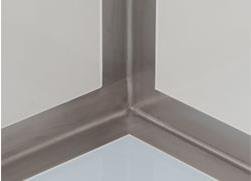
Image 1: Stainless steel corner coving with FRP wall panels.
Paneling materials such as fiberglass-reinforced plastic (FRP) and chlorinated polyvinyl chloride (C-PVC) can exist adhered to gypsum wallboard or physical walls, giving you a option between creating a modular room or converting existing office space into a cleanroom. Ceiling grids that business firm FFUs, lights and other modules can be suspended or supported in a higher place these walls, completing the enclosed interior. Both design options are less expensive than constructing a new cleanroom. Modular rooms give you the flexibility to expand, scale-downward or relocate, and then may exist preferred over existing structure.
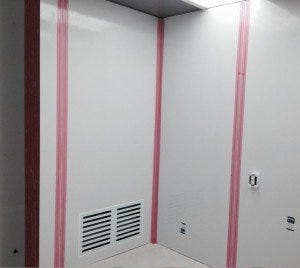
Prototype two: FRP installation in progress.
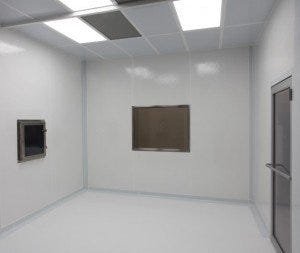
Image 3: FRP installation complete; room in "equally built" condition.
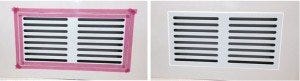
These before/after photos of wall ducts ( Epitome 4 ) forth the floor show the procedure of sealing the cracks and gaps when using FRP wall panels.
Steel ceiling grids for BioSafe® rooms are easy to wipe down for cleaning, and support all necessary modules, including HEPA or ULPA fan/filter units, fluorescent lighting, ceiling panels and options such as UV-C sterilizers and ionizing bars for neutralizing electro-static discharges (ESD). These ceiling grids peak off gratis-standing modular rooms, or can be attached to existing facility walls when a room conversion is preferred.
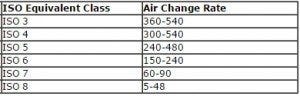 Room-side replaceable fan/filter units are ideal for aseptic rooms. Filters can exist replaced from inside the cleanroom, without breaching the enclosure. Because they eliminates the need for roof access, this reduces maintenance time and cost. Don't forget to summate your FFU ceiling coverage based on room size and ISO level, then examination your air alter rates to exist in compliance.
MATERIALS
As with so many other projects, the devil'south in the details. For example, you might consider installing an ultraviolet-C module in the ducting organisation: expose the airstream to radiation, killing airborne bacteria and viruses before they attain the FFUs. Other considerations for efficient cleanroom blueprint? Try flush-mounted pass-throughs and windows that reduce the surface area from ledges, making cleaning like shooting fish in a barrel and fast.
At present that you lot have some ideas most the pattern of the ISO v – 8 hygienic cleanroom, you lot should consider your building materials options. The first is steel. Terra'southward steel BioSafe rooms come up in powder-coated steel, or 304 or 316 stainless steel. The highest form is 316; its cost is greater, simply then is its resistance to corrosion. Stainless steel is made fifty-fifty cleaner by electro-polishing, a opposite plating process that removes metal impurities using electricity and chemicals. An ultra-smooth surface is the event: fewer peaks and valleys where particulates tin hide.
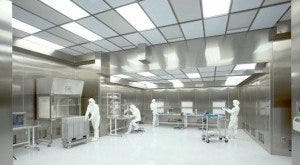
Image 5: Stainless steel hygienic cleanroom.
Plastic wall panels made of FRP or C-PVC is another choice. Seams in-between FRP panels are closed off with sealants approved for utilize in cleanrooms, and have the added benefit of expanding or contracting to arrange temperature-induced changes without slap-up. FRP panels are available as Course A or Class C; the material is similar, just the Class A is Manufactory Common (FM) approved for facilities that demand materials with low flame spread due to work with flammable chemicals or supplies. These FRP panels have a patented surfacing technology that ensures a compatible seal to enhance durability, prevent generation of particles and suppress microbial growth.
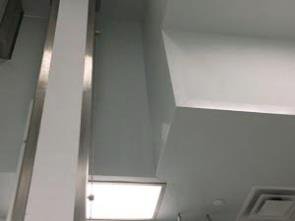
Image 6: Cleanroom wall and ceiling space covered with C-PVC paneling.
C-PVC panel seams are welded to create uniform surfaces where germs and contaminants won't gather, and their unique solvent-fee silicone adhesive allows installation on most wall surfaces. C-PVC panels are besides FM rated and certified to achieve ISO 5 cleanliness. These compressed panels offer excellent chemical resistance and prevent particle emission and microbial growth.
All of these all panel options share two important characteristics:
- They do not contribute to the population of contaminants in the room. They are non-shedding, non-out-gassing and scratch-resistant
- Almost common cleaners can be used to sterilize surfaces; they are resistant to damage from chemicals such equally isopropyl alcohol (IPA), and stand up to the rigors of hydrogen peroxide vapor and UV sterilization
CONCLUSION
Aseptic materials and room design options help companies set up to perform important medical or bio/pharmaceutical operations, as well as others requiring an easy-to-sterilize environment. You can become such a room in a few days and be set up for operation quickly, while meeting regulatory guidelines. Choices presented here should be weighed confronting budget, applications, facility limitations and preference. Learn more virtually Terra's cleanroom designs and materials here.

What Material Are Used To Build A Clean Room Grow Room,
Source: https://www.terrauniversal.com/blog/makes-room-suitable-aseptic-processes
Posted by: davisbecterrech.blogspot.com
0 Response to "What Material Are Used To Build A Clean Room Grow Room"
Post a Comment